New Arrivals Are Here
COD across India
Free shipping across India
New Arrivals Are Here
COD across India
Free shipping across India
New Arrivals Are Here
COD across India
Free shipping across India
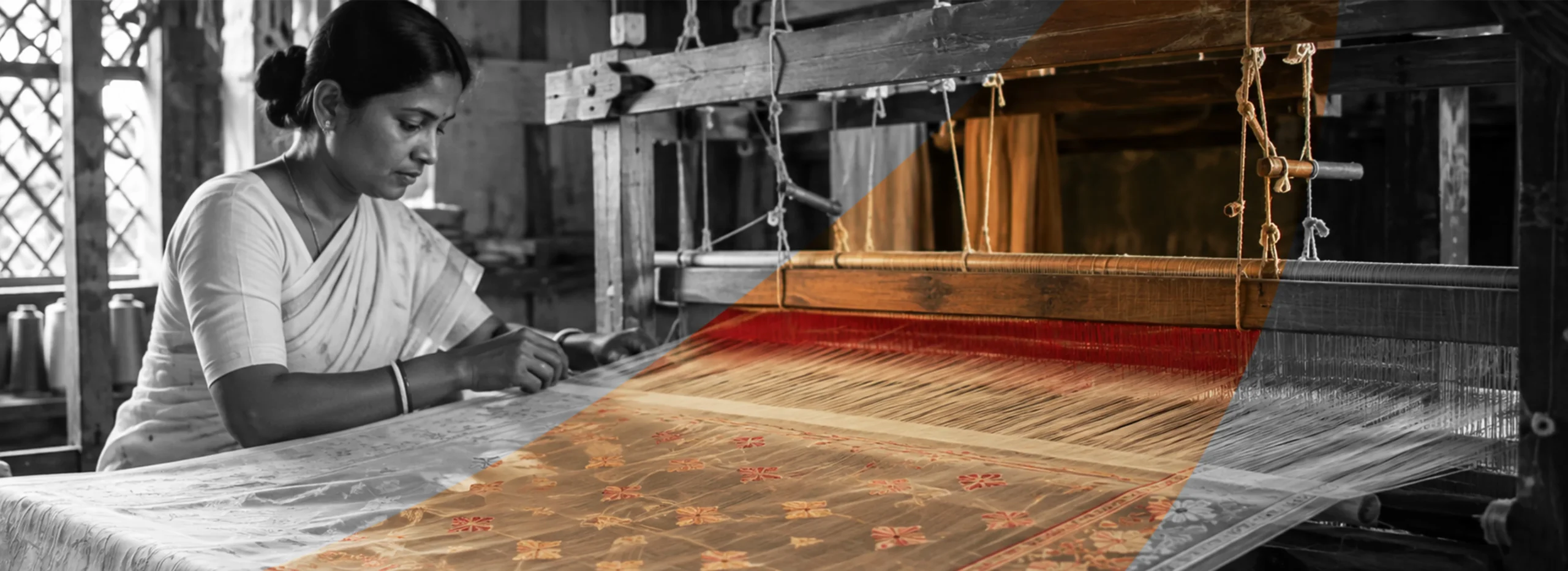
Few textiles feel as light and look as intricate as a Jamdani saree, which is why we put together this complete guide. Its motifs seem to float on the fabric, as if someone painted them on air. However, a weaver creates every flower, vine and paisley by hand, thread by thread, on a traditional loom.
In this guide, you will first learn where the Jamdani saree comes from and how weavers create it. After that, we explore the main types. Most importantly, you will also learn how to tell a genuine handwoven Jamdani from a machine-made copy. So, whether you are buying your first one or adding to a collection, you can choose with confidence.
A Jamdani saree is a handwoven saree where the weaver builds the motifs directly into the fabric. In other words, nobody prints or embroiders them on top. Instead, the weaver adds extra weft threads by hand, one motif at a time, while weaving the base cloth.
Many historians trace the name to Persian, where “jam” means flower and “dani” means vase. That fits the craft well, because floral patterns are its signature. Traditionally, weavers used fine cotton for Jamdani. Today, however, you will also find it in silk and cotton-silk blends.
As a result, you get a sheer, airy fabric with motifs that appear to rest on the surface. For this reason, women love a Jamdani saree for summer weddings, festive pujas and elegant daywear alike.
Jamdani grew out of the legendary muslin tradition of undivided Bengal, centred around Dhaka. For centuries, traders and royal courts prized the fine cotton of this region. Later, under Mughal patronage, Jamdani reached new heights, and weavers created ever finer and more ornate designs.
After the Partition of 1947, many weaving families moved to West Bengal. They settled in places such as Phulia and Shantipur in Nadia district, and also in Dhatrigram in Purba Bardhaman. There, they carried the craft forward and blended it with local styles.
Then, in 2013, UNESCO added the traditional art of Jamdani weaving to its Representative List of the Intangible Cultural Heritage of Humanity. Even today, Jamdani remains one of the proudest expressions of Bengal handloom on both sides of the border.
Weavers make Jamdani on a traditional pit loom or frame loom, and often two weavers sit side by side. Overall, the process follows a rhythm that has barely changed in generations:
Because the weaver builds every motif by hand, one Jamdani saree can take anywhere from a few weeks to several months. In fact, this slow, skilled labour is exactly what gives each piece its value.
Not all Jamdani sarees are the same. Instead, the region, yarn and design style each change the look and feel. Here are the varieties you will come across most often:
| Type | Where it comes from | What sets it apart |
|---|---|---|
| Dhakai Jamdani | Dhaka region, Bangladesh | The original style; very fine count cotton, dense and intricate all-over motifs |
| Tangail Jamdani | Tangail tradition, now also woven in West Bengal | Softer texture, bold borders, motifs often concentrated on the border and pallu |
| Shantipuri Jamdani | Shantipur, Nadia | Fine, lightweight cotton with neat, delicate motifs; ideal for everyday elegance |
| Phulia Jamdani | Phulia, Nadia | Lively colours and contemporary designs; a popular choice for gifting |
| Silk and soft silk Jamdani | Woven across Bengal | A subtle sheen and richer drape; made for weddings and festive occasions |
Generally, cotton Jamdani is the best pick for warm weather and daily elegance. On the other hand, silk Jamdani suits wedding functions, receptions and evening events.
Powerloom copies are common, and many sellers charge handloom prices for them. Therefore, use these six checks before you buy:
At Tantvithi, we source every Jamdani saree from Bengal’s weaving clusters, so you can buy with confidence.
With the right care, a good Jamdani saree can last for decades and even become a family heirloom.
A true Jamdani saree is always handloom, since weavers create its motifs by hand with the extra weft technique. Machine-made versions exist, but they only imitate the craft.
Because the weaver builds each motif by hand, one saree can take weeks or months to finish. As a result, the price reflects the weaver’s skill, time and the quality of the yarn.
Yes. Cotton Jamdani is light, sheer and breathable, so it is one of the best sarees for hot and humid weather.
Jamdani is a weaving technique, whereas Tangail is a weaving tradition that takes its name from a region. Also, a Tangail saree can feature Jamdani-style motifs, which is why people often link the two.
Yes, we welcome orders from NRI customers. Just message us on WhatsApp at 9332479214 for international shipping details.
A Jamdani saree is more than something you wear. Indeed, it carries centuries of Bengal’s weaving heritage and weeks of a weaver’s patient work. So when you choose a genuine handloom piece, you also help keep this craft alive.
Explore our handwoven Jamdani sarees, or browse the full range of hand woven Bengal sarees. You can also shop all Bengal handloom sarees on our store.
Still unsure after reading this Jamdani saree guide? Then message us on WhatsApp at 9332479214, and our team will guide you.